How a Trenchcoat-Wearing Chess Club Outsmarted Their Overzealous Principal
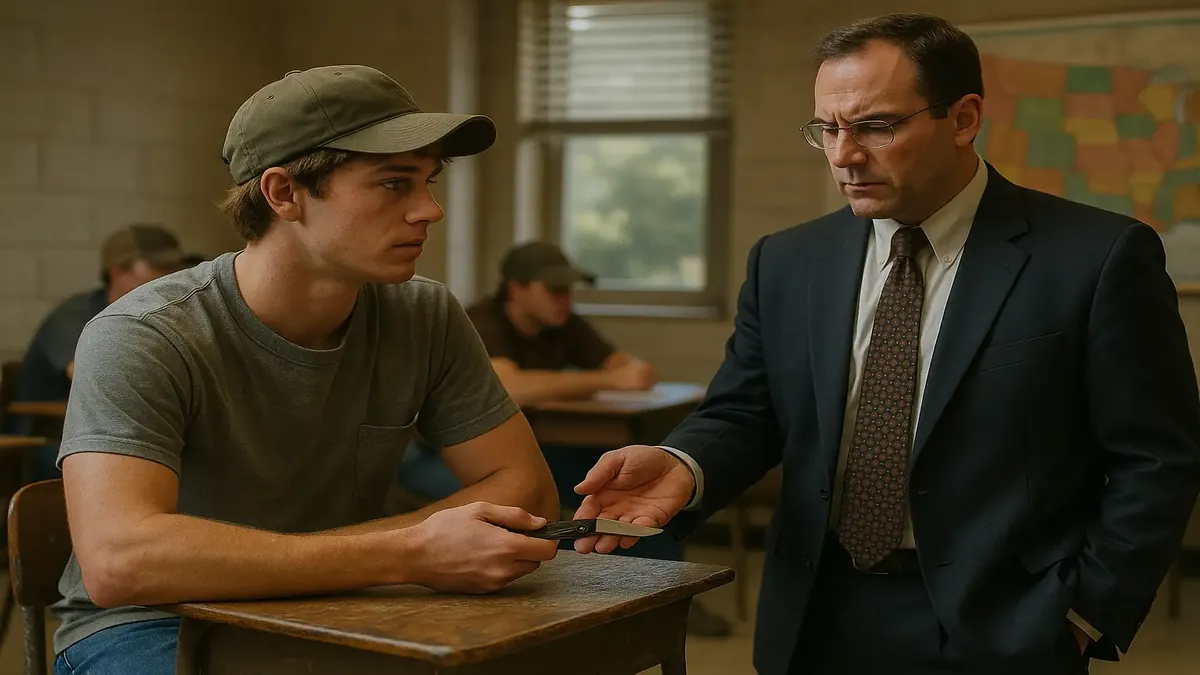
Picture this: It’s the year 2000, in a small rural town where “redneck” is more a badge of honor than an insult. The fields are dotted with tractors, and the high school dress code could be summed up as “jeans, boots, and a pocketknife in every pocket.” But in the midst of this country classic, a group of emo and goth teens—clad in black trench coats and jangling chains—quietly stages a masterclass in creative rebellion.
Enter a new principal, fresh from Dallas and seemingly determined to bring big-city order to this country chaos. But as our story’s hero discovers, sometimes the best way to fight authority is to wield its own rulebook.
No Pocket Knives? No Problem.
The saga begins innocuously enough: the new principal, aiming to modernize (or maybe just “civilize”) the school, declares pocket knives forbidden. Surprisingly, the student body shrugs it off. As one might expect in “Redneckland,” as a commenter cheekily called it, pocket knives are less a weapon than a rite of passage, but rules are rules.
Things start to escalate when the principal’s attention shifts from sharp objects to sharp fashion—and “Satanist jewelry.” Specifically, he targets pentacles worn by the emo/goth crowd. The principal’s logic? If he can’t see it in a church, it shouldn’t be in his hallways.
But as one top commenter, u/delicioustreeblood, astutely pointed out: “Freedom of religion is freedom to worship anything or nothing at all. Why is that so difficult to comprehend?” This wasn’t about safety—it was about control.
Out-Gothing the Authority: Religion, Rules, and Rebellion
Faced with the pentacle ban, the black-clad teens do what any true nerds would: they consult the school board’s official rulebook and find a loophole big enough to drive a tractor through. They declare themselves Wiccan—a perfectly legitimate religion—and refuse to remove their jewelry. Their parents, perhaps secretly proud of their kids’ strategic prowess, back them up.
The principal, undeterred, tries to push harder. But the kids know their rights, and as u/Blue_Veritas731 noted, “It was about nothing more than Control.” The school can’t infringe on religious expression, and, as another commenter, u/homme_chauve_souris, wryly observed, many Americans “think their own religion should have a special status.” But the First Amendment says otherwise.
When the jewelry ban fails, the principal sets his sights on trench coats (the 2000s Columbine-era panic looms large). There’s not much the students can do about that—coats are easier to ban than beliefs. But then, the principal makes his fatal error: he bans Magic: The Gathering at lunch, claiming it’s “too much like witchcraft” and makes others uncomfortable.
Knights, Wizards, and Checkmates: The Power of Malicious Compliance
What’s a nerd to do when their favorite fantasy card game is unjustly banned? Read the fine print, of course! The students discover a policy allowing them to form a chess club, as long as a teacher sponsors it. And here’s the twist: as long as chess is being played, any strategy game is allowed.
So, with the blessing of the rulebook, the “chess club” is born. Two students play chess; the rest, Magic. When the principal storms in, veins bulging, the students are ready. The rules say the club can’t be shut down unless it’s not “actively competing”—and even then, only the full board can dissolve it. The principal, stymied by his own bureaucracy, soon leaves the school. The club goes on to place second in the state for chess, with Magic cards still shuffling in the background.
One commenter gleefully summarized: “Beautifully played. Nothing beats using their own rules against them.” Another simply declared, “Long live the chess club.”
Community Chess: More Than Just a Game
Beyond the laughs, this story tapped into a deep vein of nostalgia and frustration. Many commenters recalled their own battles with overzealous school bans—on cards, pogs, even Gameboys. As u/Winterwynd lamented, “Our school banned all card games due to some kids getting caught playing poker and losing significant sums… We couldn’t play as it was a blanket card ban. Sucked.”
Others noted the perennial double-standards around religion and expression in American schools. “I had to get the ACLU involved when I declared myself an agnostic and refused to recite the Pledge of Allegiance,” wrote u/Antique-Agent-2992. The conversation spiraled into lively debates on freedom of religion, the Pledge, and just how many ways kids have found to sidestep arbitrary authority.
And let’s not forget the commentary on small-town quirks: “Best not to question the power of rednecks,” quipped u/Urb4nN0rd, after someone wondered what it meant to “come to school on tractors and shit.”
Checkmate, Principal
So what’s the lesson here? Sometimes, the best way to fight back isn’t loud protest, but quiet, calculated compliance. By knowing the rules better than the rule-makers, these teens turned a would-be crackdown into a checkmate—proving you don’t have to be a wizard to outsmart the system.
Whether you’re a Magic player, a chess nerd, or just someone who loves a good story of sticking it to The Man, there’s a little malicious compliance in all of us. And as this story shows, sometimes, the ultimate move is just knowing the game better than your opponent.
Do you have your own story of clever rule-bending or schoolyard subversion? Share it in the comments below—let’s keep the spirit of creative rebellion alive!
Original Reddit Post: Be careful what you ask for.