Malicious Compliance at Mach Speed: How an Aerospace Engineer Outfoxed the DoD (and the Competition)
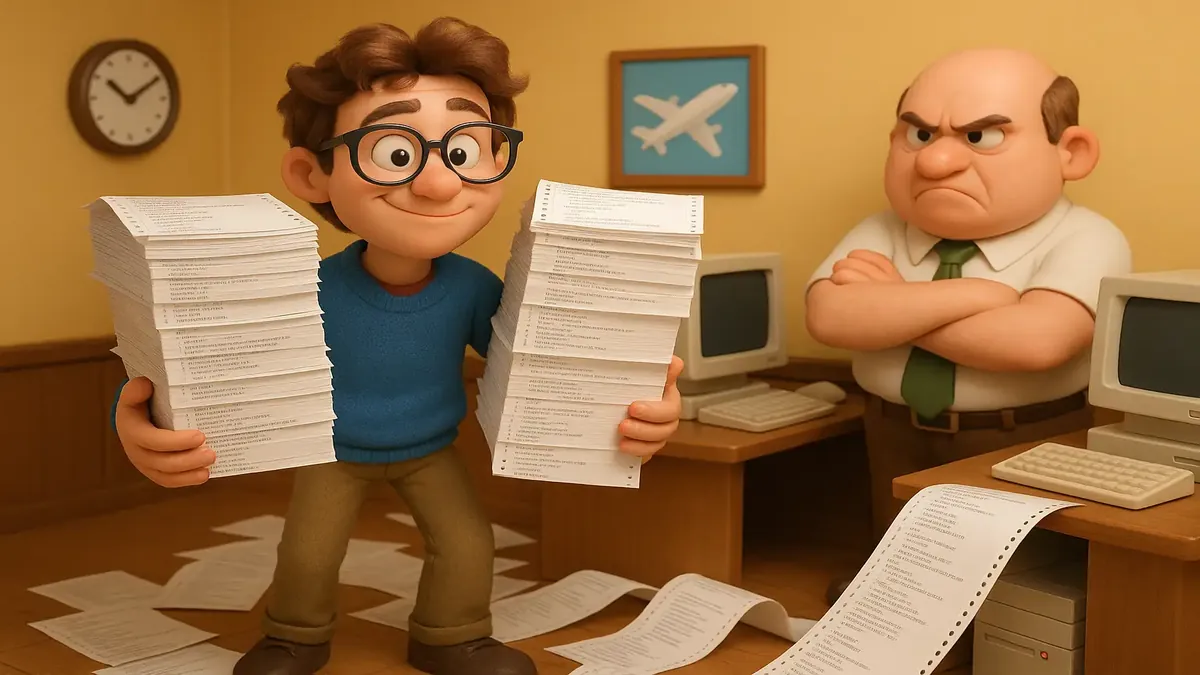
Picture this: you’re a fresh-faced aerospace engineer, moonlighting as your department’s IT wizard, and you get a request from the US Department of Defense that threatens to hand your company’s golden goose to a competitor. What do you do? If you’re the hero of today’s story, you deliver exactly what they asked—just not how they expected.
This is the tale of data, decades-old code, high-stakes contracts, and one truly epic stack of green bar paper. Buckle up, because malicious compliance in aerospace isn’t just a power move—it’s a full-throttle, high-altitude joyride.
When the Government Asks for Your Crown Jewels
Anyone with a passing familiarity of government contracts knows the real money isn’t always in the initial deal. As our protagonist from Reddit’s r/MaliciousCompliance (u/T_Sealgair) explains, “The real profit often comes from the decades of follow-on work: enhancements, modifications, new variants, new payloads…” In short, the original data and analysis from the first build are the keys to the kingdom. No data, no lucrative upgrades.
But what happens when the Department of Defense decides to shake things up and demands you hand all that legacy engineering data to a competitor—because, after all, the data technically belongs to them? That’s when things get interesting.
Enter our engineer, who was handed the mission of “delivering” decades’ worth of precious, scattered data (think mainframes, magnetic tapes, Oracle databases, and more) to the competition. The catch? The data had to be delivered, but nothing said it had to be convenient.
Compliance Level: Expert—Seven Feet of Paper and a $50,000 CD
First attempt: our hero writes custom code to extract data from every system and prints it all out. Not just a little. We’re talking a seven-foot-tall stack of green bar tractor feed paper—a monument to the art of doing exactly what you’re told… and nothing more.
As one commenter (u/PomegranatePlanet) quipped, “Wow 7 feet of 15" x 11" paper!?! That’s almost 8 whole pages of data! How could they possibly ever read all that?!?!” Of course, it was actually a tower of pages, not just eight, but the point stands: unless the competitor wanted to re-enter every line by hand, this “delivery” was all but useless.
The DoD caught on quickly. “If we ever want to win a contract again,” they warned, “we better send it in digital format.” No problem! The next round, the data was sent on mainframe tapes—easy for the company, not so much for the competition.
When that didn’t fly, the DoD demanded something even more modern. Our engineer obliged, burning the data onto some state-of-the-art (for the era) HP write-once CDs. The catch? You needed a $50,000 HP tower CD reader to access them. As u/MechanizedMonk pointed out, “I’d argue that was the BEST way to send them data at the time, not your fault they didn’t have appropriate hardware.”
But the pièce de résistance: even when the DoD finally got the real, usable data, the competitor still needed the original FORTRAN 4 source code to make sense of it—a crown jewel the company owned outright. “We graciously offered to sell them a copy for something like 10x the value of both the analysis contract and estimated value of the re-manufacturing contract,” our engineer recalls. Not surprisingly, the company won both contracts, and the aircraft in question has since flown off into retirement.
The Community Reacts: Comedy, Cynicism, and Contracts
Reddit’s aerospace crowd and armchair procurement experts had a field day with this story. The top comment from u/tsian nailed it: “And this is why governments can’t have nice things.” Others, like u/Infamous_Ad3339, worried about the taxpayers, arguing, “You guys fucked over the taxpayers to put more of our money in your pockets. Thanks for continuing the single-bidder corrupt marketplace.”
But there’s more nuance to the story. As OP clarified, the initial contract was “heavily discounted in anticipation of out-year work,” and the competitor “literally could not use this raw data without my company’s software.” In other words, the system is complicated, and sometimes what looks like sabotage is really just savvy business built around a less-than-ideal procurement system.
Some commenters, like u/MennReddit, pointed out the government’s chronic lack of understanding of what they’re actually buying: “Governments need to understand what they are buying but they often don't have the knowledge, not even the very basics.” Others, like u/NCAAinDISGUISE, saw a systemic problem: “The solution is better training for the acquisitions people, but they never feel the consequences of doing a bad job, so nothing changes.”
And, as OP later revealed in the comments, this sort of dance is standard in aerospace and beyond: “Even outside the aero world, this is common. Buy a cheap printer, then go price ink refills.” The real world is complicated, and sometimes the most “compliant” solution is the least helpful—at least for your competition.
Lessons in Loopholes and Legacy Code
So, what can we learn from this high-flying tale of malicious compliance? For starters, “doing exactly what you’re told” can be an art form—especially when billions of dollars and decades of work are on the line. Sometimes, the only way to protect your company (and your own job security) is to walk that fine line between compliance and creativity.
But there’s also a lesson here for the powers that be. As u/Blue_Veritas731 asked, “So, if you guys held the Trump Card from the beginning, why the long, drawn-out, frustrating process?” The answer, as OP explained, is that there’s always a risk: if you hand over the data in a user-friendly way, you might lose decades of future work. In a world where tribal knowledge and legacy code are king, the best defense is sometimes a good offense.
And maybe, just maybe, it’s a reminder that sometimes the most powerful tool in aerospace isn’t a jet engine or a supercomputer—but a seven-foot stack of green bar paper and a healthy appreciation for the fine print.
Conclusion: Would You Have Done the Same?
What do you think—ingenious compliance or just a symptom of a broken system? Have you ever had to “technically” follow orders in a way that made life harder for your competition? Jump into the comments below and share your own tales of creative compliance, clever loopholes, or government contract shenanigans!
And remember: next time someone demands your legacy data, make sure you’ve got enough tractor feed paper on hand. Just in case.
Original Reddit Post: Malicious Compliance in Aerospace (Kinda Long)