The Math-Challenged Customer: A Retail Tale of Discounts, Drama, and Double Dipping
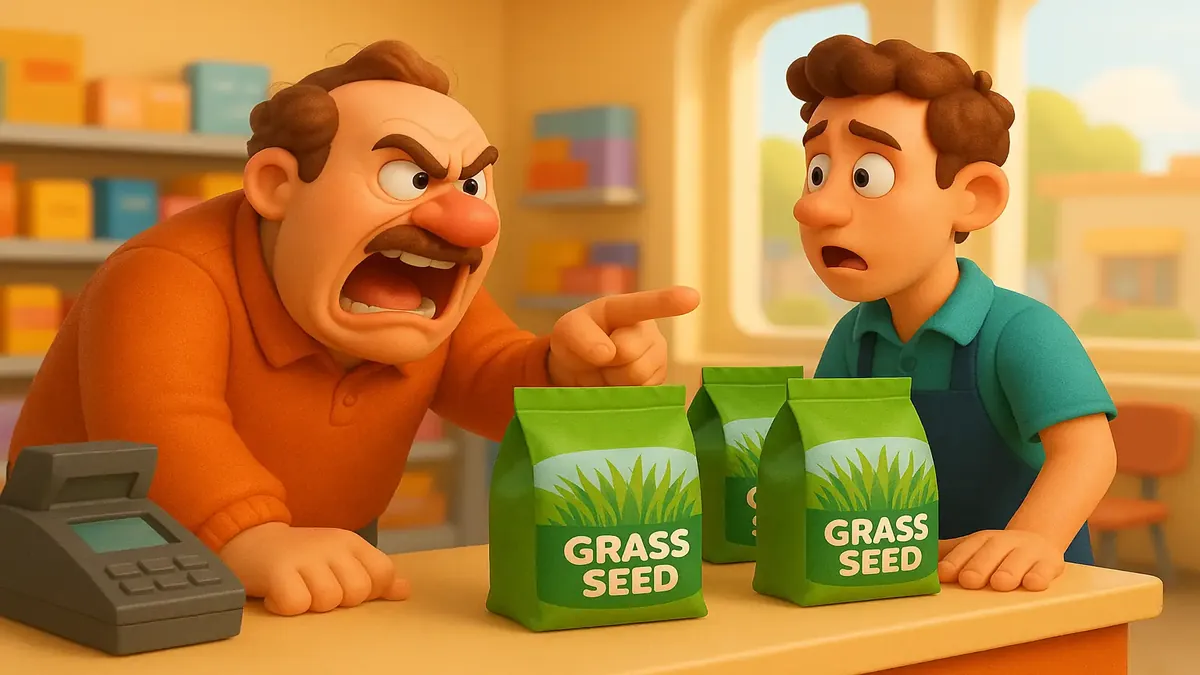
If you’ve ever worked retail, you know that simple math can sometimes be the biggest battlefield. Whether it’s a coupon that “should stack” or a customer convinced two-for-one means “free for me, pay double for thee,” discount drama is a rite of passage. But few stories showcase the true absurdity of retail math wars like the recent viral post from r/TalesFromRetail, where a $20-off grass seed sale became a case study in customer confusion, cashier kindness, and why you should never try to outwit a sign.
When $20 Off Just Isn’t Enough
Our story begins innocently enough: a customer—let’s call him Richard—approaches the register with two bags of grass seed, each originally priced at $65. The sign above them boasts a $20 off sale. But, as anyone in retail knows, what the sign giveth, the register may take away.
When the bags ring up at $49 each—a $16 markdown, not the full $20 advertised—Richard is already skeptical. Sensing trouble (and perhaps hoping for an easy resolution), our hero, the cashier (u/Salt-Maintenance6857), tries to make things right by giving Richard a generous additional $10 off per bag. That’s $26 off each. Surely, that will make Richard happy, right?
Not so fast. Richard, in a feat of mathematical gymnastics, insists he should get $40 off per bag: $20 for the sale, and another $20 for the sign. “No, girl! $45 minus $20. Are you stupid? Where the f-ck did you go to school,” he barks. (For the record, the bags were never $45, but let’s not let reality get in the way of a good tantrum.)
The cashier is left blinking in disbelief, pondering how someone could get so lost in the simple arithmetic of retail discounts. As she recounts, “Dude already looked like a f---ing foreskin, like how are you gonna sit here and be the rest of the d-ck too?” Richard storms off, never to aerate his lawn—or his attitude—again.
Retail Math: The Bermuda Triangle of Logic
This story quickly resonated with the r/TalesFromRetail community, sparking a flurry of laughter, sympathy, and seasoned advice. Several commenters pointed out that, while the cashier’s heart was in the right place, the attempt to be “extra nice” with an additional discount probably made things murkier for Richard.
As u/chortle-guffaw noted, “You meant well, but the added discount just confused the issue. Next time, just fix it so it's the correct price.” The original poster [OP] jumped in to clarify: the register had only taken $16 off automatically, not the full \(20, so she was merely correcting a system error—but with a little extra generosity thrown in. The crowd suspected that, no matter the approach, Richard would have found a way to argue. “He was arguing the discount should be -\)40 per bag. $20 off what the computer rang up as, which already included $16 of the discount. He wanted the discount twice. I can not explain why he thought it worked that way,” OP explained.
Other retail veterans chimed in with their own tales of discount misadventures. One user, u/elijahjoseph03, shared, “I had someone like this once. Post-Christmas, lots of seasonal stuff was 90% off and some only rang up 30%. This woman asked me to take 90% more off. Got mad when I told her I can only do 60% more. She insisted that she was right and that I was bad at math.” It seems the Richard method of discount stacking is a recurring phenomenon.
The “Double Discount” Illusion
So, why do customers like Richard believe in the mythical double discount? u/KnottaBiggins broke it down brilliantly: “He thinks that means they're $20 off of $20 off. In other words, $40 off. Okay, he passed 2nd grade math. But he failed 3rd grade reading comprehension.” The community rallied around this point, with many noting that confusion often arises when customers assume every sign, promotion, or sticker should stack on top of each other—even when it’s clearly the same deal.
And then there’s the issue of customer entitlement. As u/Celistar99 lamented, “That's what you get for doing something nice for a customer. Give them an inch, they'll take a mile. Those are the ones who ruin it for everyone else.” Many commenters agreed: kindness in retail is often mistaken for weakness, leading to more demands instead of gratitude.
When Kindness Backfires
The consensus? Sometimes, the best customer service is simply sticking to the advertised deal—no more, no less. As u/Affectionate_Glass_1 put it, “I would’ve been petty as soon as he called me stupid. Would’ve gone back and just fixed it to account for the advertised $20 off and not given any extra. Then when he complained about it again, ‘I’m sorry, you were right, I WAS stupid. I gave you more off than I should have. I fixed it, though. It’s ringing up correctly now, $20 off the original listed price of $65.’”
Others advocated for even firmer boundaries: “At that point cancel the transaction and tell him to leave the premises,” advised u/Dr_StrangeloveGA. After all, there’s only so much abuse a cashier should have to take—especially over grass seed.
On a lighter note, the community didn’t hold back in roasting Richard’s mathematical prowess. “Guy couldn't count to 21 with his clothes on,” quipped u/weirdal1968, giving credit to comedian Joan Rivers for the zinger. If only retail workers got a dollar for every time they heard that joke in their heads during a shift.
Conclusion: Math Is Hard—But Empathy Shouldn’t Be
The next time you see a sale sign, remember: the discount probably isn’t a coupon to be used twice, no matter how passionately you argue. For retail workers, stories like this are a daily reminder that patience and clear communication are key—but sometimes, the best you can do is stick to the math and let the customer storm off with their dignity (and their full-priced grass seed) intact.
Ever had a run-in with a “discount double-dipper” or a customer who thought the rules of math didn’t apply to them? Share your story in the comments below—let’s keep the retail therapy going!
Original Reddit Post: Customer got mad I didn’t give $20 off an item that was on sale by $20