When Store Policy Meets Customer Fury: The Great Return Stand-Off
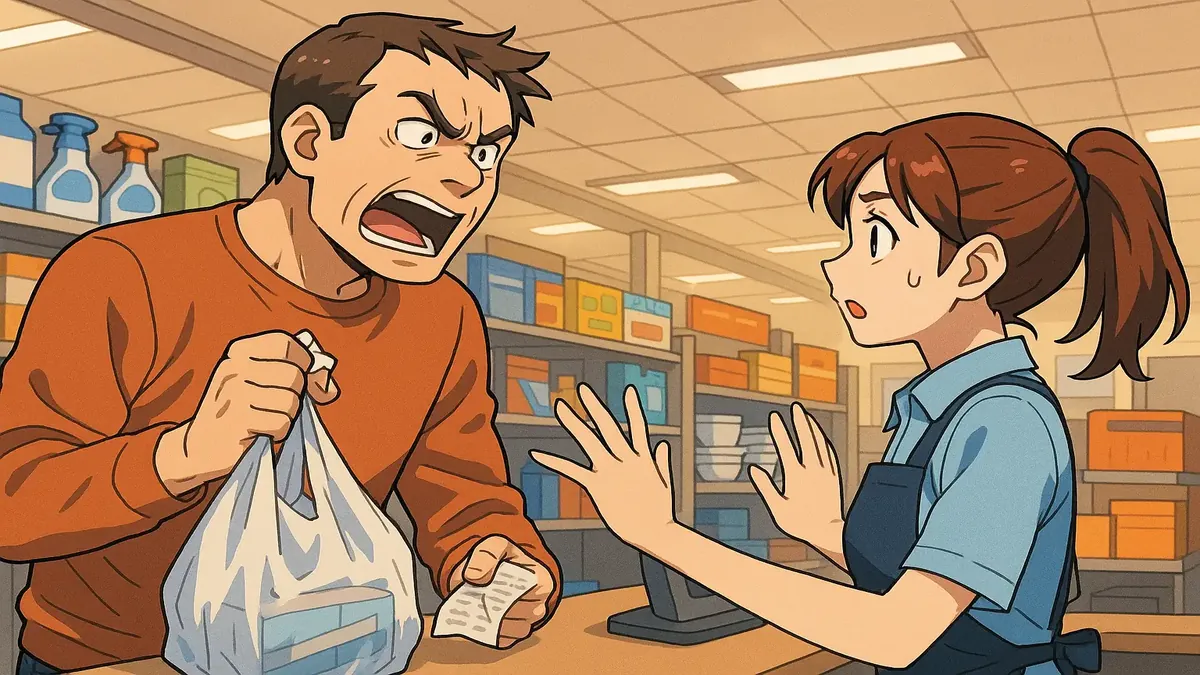
It was a quiet day at the home goods chain—until a customer stormed in, plastic bag in hand, and a receipt already crumpled with rage. He was on a noble quest: to return a small appliance that had failed him almost immediately. The catch? He wanted to return it at a location different from where he bought it. After all, as he repeatedly pointed out, “It’s all the same company!”
If you’ve ever worked retail, you might already be feeling a phantom headache. This scenario, first recounted on Reddit’s r/TalesFromRetail, quickly spiraled into the kind of theatrical policy debate that only a customer service desk can host. But was the customer truly unreasonable? Or does the system need a reboot? Let’s dig in.
The Return That Launched a Thousand Sighs
The story’s author, u/Sh4d0wCrescent, recounted how the customer, already simmering, demanded a refund at a different location than where he’d purchased the item. Our hero—the cashier—explained that, despite the matching logos above their heads, the stores operated with separate tills and inventories. The cash register simply wouldn’t process the return without jumping through a series of technical (and bureaucratic) hoops.
The customer was unimpressed. To him, the matching logos were a legal contract: buy from one, return to any. He accused the cashier of laziness, pointing at the receipt and the sign overhead as if he’d cracked the Da Vinci Code of retail. When the supervisor backed up the cashier, offering to circle the correct store’s phone number, the customer declared customer service dead and stormed out, still clutching his now villainous shopping bag.
Whose Side Is Retail On? The Community Weighs In
If you’re thinking, “Doesn’t every big chain let you return stuff anywhere?”—you’re not alone. The top Reddit comment, from u/cydril, echoed this sentiment: “A lot of chains let you do returns to any location so I don't think this was an unreasonable ask tbh.” Several users chimed in with regional perspectives, noting that in the US and Australia, this kind of cross-store return is practically expected. As u/georgecm12 put it, “I don't know of any chain of retail stores that don't allow you to return product at any of their stores, regardless of where it was purchased.”
Yet, not everyone was Team Customer. u/ceciliabee offered a key distinction: “To ask, totally. To escalate until you're loud enough to bring over a supervisor, be rude to the cashier, and act like a piss baby when you don't get to make the rules? That's another story.” In other words, it’s one thing to be confused by policy—it’s another to audition for a daytime Emmy at the returns counter.
Others highlighted the nuances: independently owned franchises often have separate return policies, and sometimes the register systems themselves simply can’t process out-of-store returns. As u/Techsupportvictim explained, even within a movie theater chain, tickets from one location are invisible to another’s system: “We are basically identical except for one of us is on Main Street and one of us is on State Street. And the number of times I’ve had people try to argue with me that I need to return their tickets from State Street because they’d rather see the movie at Main Street or whatever is vast.”
Is the Policy the Problem, or Is It the Delivery?
While most agreed the customer’s attitude was out of line, plenty of commenters sympathized with his confusion—and frustration. After all, as u/Historical_Freedom58 argued, “It’s a major failure in customer experience to expect people to navigate corporate logistics just to return an item.” In today’s world of online shopping and hassle-free returns, being told “the computer says no” feels like a relic from another era.
Some, like u/CapoExplains, even wondered if the OP could have overridden the system: “Sounds like you could've taken the return but 'didn't feel like doing the paperwork.' What does overriding those steps involve? Is it illegal or a violation of company policy? Or is it just extra paperwork?” This raises a familiar retail worker’s lament: Sometimes, saying “no” is more work than just punching a few extra buttons, but policies (and, more often, software) are what they are.
And then there’s the human factor. As u/K1yco put it, “I hate this argument that we are avoiding it because it's a lot of work. I would be happy to do it as me telling you no is actually the part that's causing more work, otherwise I would have already done the so-called 'simple' thing you want me to do.”
The Unchanging Laws of Retail Physics
So who’s right? The answer, as in most retail tales, is “it depends.” Customers expect convenience—especially when the branding screams uniformity. But sometimes, the store’s system is set in stone, and no amount of gesturing at a logo will magically merge inventories or tills. As the OP pointed out, “Stuff like this isn’t rare, but the confidence some people have while being completely wrong still gets me.”
The real lesson? Everyone’s time would be better spent if companies clearly communicated their policies (ideally at checkout), and if customers saved their Oscar-worthy performances for the stage—not the returns desk.
Conclusion: Your Move, Retail
Have you ever been caught in a tug-of-war between customer expectations and company policy? Do you side with the customer’s logic, or the realities of retail software and franchise weirdness? Drop your own retail war stories, policy pet peeves, or tales of customer “confidence” in the comments below. After all, wherever there’s a returns desk, there’s a story waiting to be told.
Original Reddit Post: Customer insisted our store had to refund an item from a different location because 'it's all the same company'