Why Do We Still Do It That Way? The Hilarious Legacy of “Good Ole Russ” and Tech’s Most Persistent Mysteries
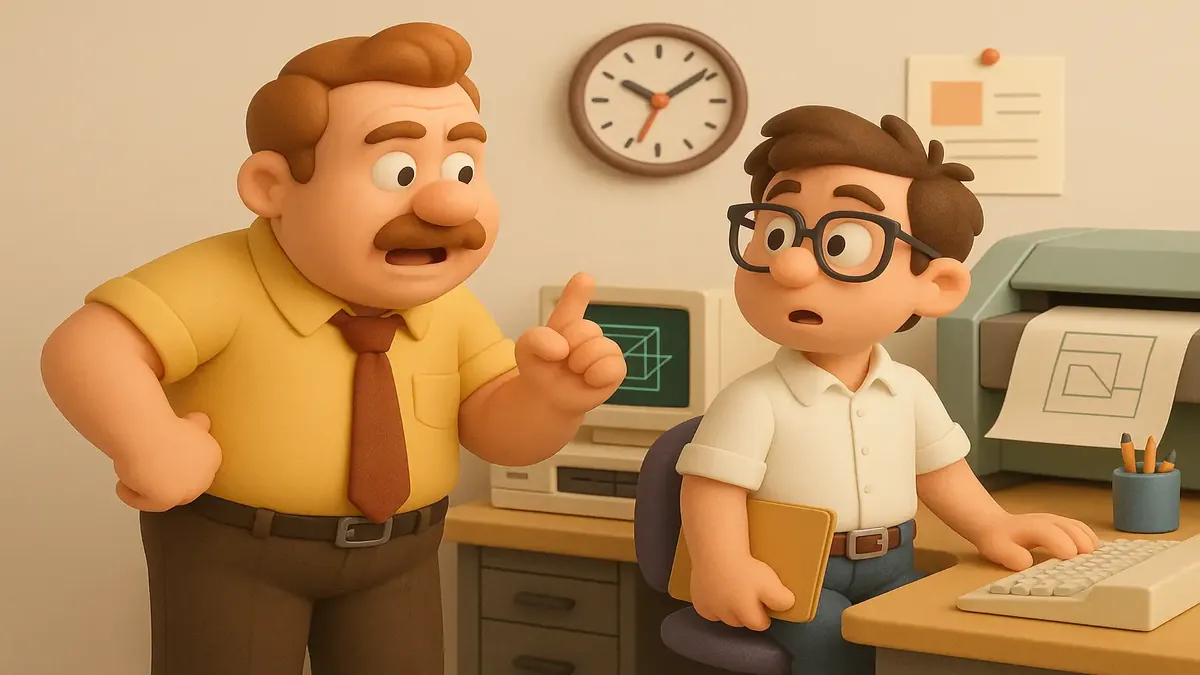
Have you ever looked at a baffling company process and wondered, “Who thought this was a good idea?” You’re not alone. Sometimes, the answer is less “best practice” and more “because Russ liked it that way in 1983.” Today, we’re diving into a real-life tech support saga from Reddit that proves the only thing more persistent than data is tradition. Buckle up for a journey through the tangled roots of “we’ve always done it this way”—where consistency, mystery, and a cross-eyed draftsman named Russ leave their mark on thousands of blueprints (and countless confused engineers).
The Great CAD Conundrum: When Consistency Gets…Weird
Picture this: It’s the 1980s. Our hero, u/critchthegeek, is wrangling a sprawling CAD system for a major engineering operation. With thousands of product units and decades of drawings to standardize, you’d expect some quirks—but nothing prepared them for the “interior series.” You see, every drawing was dimensioned right-to-left—except, weirdly, for this one series, which ran left-to-right. No one knew why.
Engineers, architects, even the production team all shrugged. Then, finally, the answer emerged from an engineering manager with 25 years under his belt—and it was a doozy: “Good ole Russ” was cross-eyed, and left-to-right was just easier for him to read. That’s right—thirty years and thousands of drawings later, a company-wide standard still existed just to accommodate Russ, who’d retired decades ago.
As hilariously absurd as it sounds, this is the kind of story that tickles every techie’s funny bone—and sends shivers down any process improvement manager’s spine.
Why Old Habits Die Hard (and Sometimes, for Good Reason)
This isn’t just a one-off oddity. The comments section lit up with stories of businesses clinging to ancient methods, often for reasons long forgotten. As u/thatburghfan shared, even after 120 years in business, their company still produced a few hundred parts unchanged from the 1920s. Every so often, someone would suggest a “better” way—only to discover the old method, for reasons lost to time, still outperformed the new.
It’s the paradox of institutional memory: change is risky, especially when no one remembers why you do things a certain way. “If you are wrong, be consistently wrong,” recalled u/Kudzupatch, a trained draftsman. Consistency, even in error, trumps chaos. It’s a mantra echoed in software, too—u/harrywwc reminisced about modifying legacy code: “think like the original programmer, and make the changes in the same way.”
But what if you can’t find the reason? As u/Ok-Secretary455 lamented, “I know there’s a reason they do it Y way. That reason probably has a whole cascading effect downstream. But no one remembers why they went with Y way.” When the original logic is lost, every change becomes a leap into the unknown. Are you “fixing” a problem, or breaking a hidden dependency that’s kept the whole rickety system afloat?
Tradition, Traps, and the Chesterton’s Fence Principle
Of course, not all legacy quirks are sacred cows—we just treat them that way. Some commenters brought up the classic “Chesterton’s Fence” principle: never tear down a fence until you know why it was put up. As u/KelemvorSparkyfox pointed out, OP did their due diligence—asking everyone before discovering the Russ Revelation. Sometimes, the answer is practical. Other times, it’s just tradition masquerading as necessity.
And sometimes, it’s just plain funny. “Sorry about my code,” quipped u/failed_novelty, “It seemed like a good idea at the time. And, to be fair, we met the deadline.” Who among us hasn’t made a choice under deadline pressure that lived on longer than we ever imagined?
But tradition also has its defenders. As u/EthicalLapse observed, what looked like a bizarre workflow was, at heart, an early attempt to accommodate a worker’s disability—a rare win for inclusivity, even if it outlived its purpose.
When Change Means Embracing (or Surviving) Quirkiness
So what’s the takeaway for today’s engineers, IT folks, and process nerds? First, institutional quirks are everywhere—sometimes for good reason, sometimes just because. Before you go full “disruptor” on a weird old standard, do your research. The story of “Good ole Russ” is a lesson in humility: sometimes the logic is lost, sometimes it’s just plain human.
And as u/Corgilicious suggested, maybe it’s time for a “tradition treasure hunt”—gather the team, grab some pastries, and dig into why you do things the way you do. Don’t judge, just understand. You might find a nugget of wisdom…or a decades-old inside joke.
Finally, remember: if you ever find yourself cursing a bizarre process, you’re not alone. Somewhere out there, an entire plant might be following a standard set by a guy who just needed to see things a little differently. And maybe, just maybe, that’s not such a bad legacy after all.
Share Your Own “Russ Rules”!
Have you uncovered a hilariously outdated company practice? Does your workplace still “do it that way” for reasons lost to the ages? Drop your best (or worst) tales of tradition in the comments. Let’s see just how deep the rabbit hole goes—because if there’s one thing tech loves more than innovation, it’s a good story about why we’re still doing it the old way!
Original Reddit Post: Because we've always done it that way.